Showing posts with label pre-assessment. Show all posts

Sunday, October 13, 2013

Revised APPR Assessments Part 2: 1st Grade

In my last post, I told you about my revised assessment for Kindergarten, which is serving this year as my LLO portion of my APPR.  In this post, I'll share how I changed the rubric for my 1st grade assessment and why.

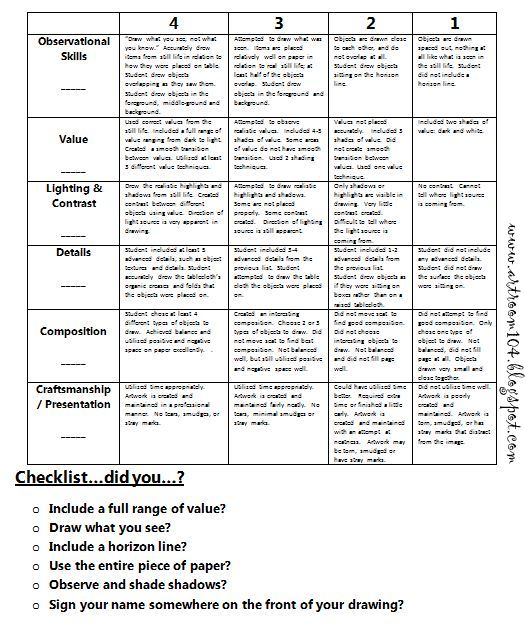
Last year, 1st grade served as part of my SLO and while the assessment itself was a great thing, the rubric I had created was just too simple and hard to get a good, accurate measurement of growth out of.  You can see the post I did at the end of last year here.   This assessment involved asking the students to draw 6 things in 6 squares.  They were to be assessed on the subject itself, use of a horizon line, use of colors, and craftsmanship, but because of the way the rubric read, it was very difficult for the other art teacher who assessed my tests to give an accurate grade.  For one drawing, a student might have received a 4 for one aspect of their drawing but a 1 for another, which made it difficult to give a solid score for each drawing.

It was also hard to assess the "draw anything you want" square because let's face it, a lot of the 1st graders just drew "scribbled abstract art".  In the end, I didn't meet my 80% mark of students who met or passed my goal...I only had about 65% of students meet or exceed the goal.  So, here is how I changed this assessment for this year.

The first thing I did was change the six items students need to draw.  Now, they have to draw a fuzzy dog, a rainbow, a tree, a landscape, a self-portrait, and a still life.  I like the change in the last three options because now they have to prove that they learned content as to what those three subject types are.  I also changed my rubric.  It's a little bit more complex now, but I think it will be a lot easier to grade these drawings and get a more accurate show of growth.  

1st Grade: 6-Square Drawing Test


Fuzzy Dog

Texture & Color   
Student used appropriate colors for the subject and details drawn.  Student made object look like it has the appropriate texture.
    
     4        3       2       1       0
Dog Body
Dog body is drawn accurately and looks like an actual dog.
     4        3       2       1       0
Background
Student included appropriate details in the background for the subject, including a horizon line.  Sky is colored all the way to the horizon line.
      
    4        3       2       1       0


Tree

Texture & Color
Student used appropriate colors for the subject and details drawn.  Student made object look like it has the appropriate texture.
     
     4        3       2       1       0
Tree Structure
Tree contains all appropriate parts (trunk, branches, leaves and possibly roots).  “Cloud tree”=3, “ice cream tree”=2, “lollipop tree”=1.  No tree=0.
    
     4        3       2       1       0
Background
Student included appropriate details for the subject in the background, including a horizon line. Sky is colored all the way to the horizon line.
       
     4        3       2       1       0


Rainbow

Color Order
Correct colors ROYGBIV & order = 4
Correct colors ROYGBV & order = 3 (no indigo)
Correct colors but not in order (or missing 2 colors) = 2
Did not use correct colors but has 3 colors present = 1
Used 1-2 colors (or no rainbow) = 0
    

     4        3       2       1       0
Background
Student included appropriate details for the subject in the background. Sky is colored all the way to the horizon line (if one is included).
    
     4        3       2       1       0
Craftsmanship
Student used neat coloring.  Colored the entire square.  Sky is colored all the way to the horizon line; ground is colored from the horizon line down to the edge of the square.
       
     4        3       2       1       0

Landscape

Type of Art
Student correctly drew a landscape.  Included images from outside where the nature is more important than man-made objects.  (Mountains, sky, sun, grass, weather, animals, etc.)
    
     4        3       2       1       0
Details
Used appropriate colors for the subject and details shown. 
    
     4        3       2       1       0
Craftsmanship
Student used neat coloring and colored everything.
       
     4        3       2       1       0

Still Life

Type of Art
Student correctly drew a still life.  Drawing is of inanimate objects such as a vase of flowers, plants,  fruit, cups, dishes, etc.
    
     4        3       2       1       0
Details
Used appropriate colors for the subject and details shown.  Included a horizon line.
    
     4        3       2       1       0
Craftsmanship
Student used neat coloring and colored everything.
       
     4        3       2       1       0

Self-Portrait

Type of Art
Student correctly drew a self-portrait.  Student drew a picture of him or herself.

     4        3       2       1       0
Details
Used appropriate colors for the subject and details shown.  Included all appropriate facial features (eyes, nose, mouth, ears, hair, eye brows, freckles, glasses, etc.).  If a body is included, student has shown all appropriate limbs (neck, arms, legs, feet, hands, torso, etc.).
    

     4        3       2       1       0
Craftsmanship
Student used neat coloring and colored everything.
     4        3       2       1       0
4=Advanced                  3=Satisfactory             2=Improving         1=Needs Improvement            0=Incomplete

________________ / 72 points = __________________ %


Friday, October 11, 2013

Revised APPR Assessments Part 1: Kindergarten

I didn't really share the outcome of my post-assessments last year, mainly due to the fact that there was some confusion around them with calculations.  In the end, I "passed" and did all right, but my results weren't exactly where I wanted them to be for the post-assessment scores.  Thus, I revamped two of my assessments.  Last year, I did my SLO assessments in 5th, 2nd, 1st and Kindergarten.  My LLO was in 4th grade.  Lucky for me, I have one less to do this year!  This year, my SLO assessments are with Studio Art, Art 7, and 1st grade and I chose to use Kindergarten for my LLO so I could revamp my rubrics.

Today is our first Staff Development day and luckily, I have no place to be except in my classrooms working on my SLOs and LLO, which are technically due today!  In the next few posts, I'm going to share with you my old assessments from last year and what I plan on doing differently this year.  I'll also share with you how I am setting my goals, as I am doing something completely different this year as well.

Last year I did a cutting and gluing rubric and I had a 97% success rate at students passing, which was great, but made it seem as though the assessment wasn't quite as rigorous as it should have been.  So, this year, I changed up my plans for the Kindergarten assessment, and I've actually changed my mind twice about the pre-assessment.  Back in September I shared a post with my ideas for this year, which you can see here.  I originally gave students a shape sheet with fewer shapes and then a quiz that quizzed them on shapes, lines and basic color theory.  I was struggling to figure out how I would make sure those kinders could read their color words by the end of the year to take a "quiz" (since I would essentially have to create a test bank), and then I decided to scratch that idea, after I had already given out that assessment.

Now, I've decided to continue using the shape sheet for cutting and gluing but also the Hey Diddle Diddle Shape Cow project we just did.  This way, I am still assessing their cutting and gluing skills, but also their ability to draw shapes, their use of crayons and how they color.  As I looked at all of these projects, I realized that even though I was trying to teach them how to use the shapes and how to color properly, it's going to take a while for them to improve, so I should still be able to show growth.

  
These are the two activities being used for the kindergarten pre-assessment...

And these are the two rubrics being used for the kindergarten pre-assessments...

At the end of the year, students will then be assessed on cutting & gluing, as well as their coloring and shape skills all in one project...the primary playground project!  In that project, students have to cut out their own shapes and create a playground.  It will assess their ability to cut out shapes that are discernible from one another, how well they glue the shapes down (still using the dot glue method), and how well they utilize their entire paper.  Last year I did this as a review projects for primary colors and shapes, but it'll make a great end of the year assessment, I think.  Instead of having the students do it on 9"x12" paper, I'll give them the bigger sheets like I did for their pre-assessment cows.
 
Two kindergarten examples from last year, done back in February.

And this is the revamped rubric for assessing the post-assessment.

I know these rubrics are hard to read...I'm doing this at school right now and don't have a nicer way of taking a screen shot, so you can find them on the SmARTteacher.

Saturday, September 14, 2013

First Full Week: Elementary

Wow, so after the first two days and this first full week, I have finally seen every elementary student once!  Today was day 1 in the cycle, so the rotation started again and I saw a few classes for a second time.  I think I'm really going to struggle with getting students to work a bit faster.  I hate rushing them, but we aren't going to have time to do very many art projects this year with the elementary schedule!  I'm always talking about taking their time and having good craftsmanship, but I was trying to push them along today so we could begin the first unit!  (Problem is, they're very chatty right now, so they aren't actually working like they should be.  I know that's why they take so long to finish projects, but they don't know that...they just get confused because Mrs. Impey tells them to take their time but then tells them to hurry up!)  That is going to be my big struggle with elementary this year, I just know it!

Anyways, here are two of my three bulletin boards.  Between faculty meetings, doctor appointments and one-on-one meetings, I'm ashamed to say I still have a blank bulletin board!  Eek!  Oh well, I think I'm entitled to be a bit behind since I now I have three bulletin boards and 2, sometimes 3 display cases that I'm responsible for!

Here is my almost-finished "Art Is..."/"Art Isn't..." bulletin board.  We finished the post-it part in every class, but didn't finish the other illustration part.  I'll be able to fill the rest of the empty spots this week as I see the classes for the second time.  I did this as an opening project with the 4th-6th graders, and the 3rd-6th 12:1:1 class.

This group of 6th graders had the color theory curriculum last year.  I was impressed by the "Art is Cool" one, where the student remembered the cool colors (especially since that student is color blind too!).


And here is the Van Gogh's Vase board.  These classes all finished their flowers...2nd and 3rd graders, plus the K-3 12:1:1 class did these.  I just need to make a sign to hang telling viewers who did the flowers.  (I plan to get my 3rd bulletin board up on Monday...the K-1st graders did Kandinsky circles.  1st graders did cut construction paper and the kinders just did colored crayon circles.  I had to take more time going over the rules with the kinders so I didn't want to change scissors and glue just yet!)

I was particularly impressed by this student...he is in the 12:1:1 class and in the past, has not been very good at concentrating on coloring in the lines.  He spent the entire time working and concentrating so hard on coloring his flower!  This is the best coloring job I've seen him do, and it was only the first week of school!

So, now that I'm finally seeing the kids for their second art class, we're starting to get into our first units for some, and pre-assessments for others.  My kindergarten students will be serving as my LLO this year.  I had a 97% passing rate on my post-assessment with the cutting & gluing exercise, so I want (and my administrator wants) to beef up the assessment a bit, because it is probably a little easy.  So, I've decided to add a simple drawing component and some kinder-color theory.  Since we do primary and secondary colors in kindergarten, that's probably something safe to assess their memories on.  I also do a lot of basic drawings of things like the cows and such using basic shapes...so shape recognition and drawing skills can be assessed at the end of the year as well.

New shape sheet has 7 shapes and one line to cut out instead of 9 shapes and two lines.  The two lines confused the students last year a bit, I think.

This will assess the secondary colors (and if I wanted to, at the end of the year I could assess their ability to read these color words and shape words as sight words).  Also, drawing a square, circle, triangle, rectangle and five different kinds of lines.

My 1st graders will also be making up the rest of my SLO portion with the two high school levels.  With them I cover 54% of my student population based on class level sizes and the amount of time I see them during the school year.  My 1st graders will be doing the 6-square drawing test again, but I'm going to be altering my original rubric.  The alteration is still in the process.  I had an OK success rate with that assessment.  The rubric was the main problem in grading those assessments.  I'm also changing what the students will be drawing.  Last year they had to draw a fuzzy dog, a rainbow, a flower, a tree, their family and anything they wanted.  Of course, the "anything they wanted" part for some was just scribbles.  So, this year, they will be drawing a fuzzy dog, a tree, a rainbow, a landscape, a still life and a self-portrait.  This was, some content vocabulary and recognition can be used as well.  More on that as I redevelop that rubric.

In 6th grade, we will be jumping into cave art.  Last year I didn't do a prehistoric unit with the six graders because by the time we got through pre-assessments and such, I missed the opportunity to match it.  That unit is a quick one in social studies.  So, this year I'm starting it right away with hopes of giving them so background knowledge on the subject to help in social studies.

5th grade will be jumping right into color theory.  I did a little of the color wheel with them last year, so we are starting off by making generic color wheel plates and I'll have them keep track of the color theories that they learn about on the back over the course of the year.  I had been hoping to get tertiary colors painted in the same class as well, but they took too much time (being "Chatty Kathys") finishing up their "Art Is..." illustrations.  We will finish these next class and then jump right into the complementary color checkerboards.  I decided to skip the painted color wheels where I have them make a symbol to represent themselves because that just took way too long last year to complete.

For 4th grade, we are jumping right into using value.  We will do the fall leaves linocut project and the fall tree with value drawing that I did last year.  That project is always a big hit with 4th graders.

Third grade?  Not quite sure what I'm doing with that group yet...but 2nd grade is currently doing the Common Core NYS listening and learning strand about fairy tales, so I'm sure I can come up with something there.  Hmmm...the thought that just came to me is that they just did Beauty and the Beast...maybe some stained glass castle windows?


Monday, August 26, 2013

High School Observational Drawing Rubric

Taking a break from my curriculum planning, I've been working on my pre- and post-assessment plans for my high school SLOs for this year.  I've decided it's going to be a two-part assessment.  Although I was lucky enough last year on the elementary end to not have to incorporate any writing pieces, I'm being asked to incorporate a writing component on the high school end, so here is my plan.

The first part will be an observational drawing of some sort.  I plan to use the same observational drawing rubric for both 7th grade and Studio Art.  At this point, I'm not sure if I'll have them do the same subject, but I do know that I want the Studio Art students to draw their hand.  (The teacher I graded post-assessments last year did this and I liked it!).  The first drawing will be a one-day drawing and the post-assessment will probably be a 2-3 day drawing, where hopefully the students will incorporate more creativity in the pose and background of their hand.  I'm debating about having 7th graders do their hands as well, or a still life, or quite possibly their shoe (or maybe even a self-portrait!).

Here is my preliminary observational drawing rubric that I've been working on today.  It is a combination of ideas taken from the regional art assessment rubric that we created last year at Boces, and some of my own ideas.


4
3
2
1
0

Technical Accuracy

_____

“Draw what you see, not what you know.”  Accurately drew shapes, proportions, contours and details. Drawing is expressive and detailed.
Attempted to draw what was seen.  Attempted to draw proportions correctly and points of overlap.  Drawing is expressive and somewhat detailed.
Somewhat drew what was seen however proportions are not exact; student did not observe and draw points of overlap.  Drawing is somewhat detailed.
You can tell what the student was observing in the drawing, but proportions are not correct.  Did not observe and draw any points of overlap. Drawing lacks almost all details.
Student did not do an observational drawing.  Drawing has no details.

Shading/Value

_____
Student successfully incorporated all 8 ranges from the gradient scale with smooth transitions. Student used at least 3 shading techniques to create value. Student accurately observed and shaded highlights and shadows, and the direction of the light source is apparent.
Student incorporated 6-7 ranges from the value scale with smooth transitions.  Student used 2 shading techniques to create value.  Student observed and shaded highlights and shadows.  Viewer can see where the light source comes from.
Student incorporated 4-5 ranges from the value scale with rough transitions.  Student used 1 shading technique. Some highlights and shadows are observed, but not very accurately and they do not match the light source.
Student incorporated 2-3 ranges from the value scale with very rough transitions.  Only used 1 shading technique.  Very vague representations of highlights, shadows and light source.
Did not create value in drawing.  No transitions.  Only black and white.  No shading techniques used.  No highlights, shadows are light source are drawn.
Elements of Art

_____

Student understands and uses the elements (line, shape, form, space, texture, value, & color) to create a successful and interesting artwork. Student has a strong sense of line, both real and implied.
Student uses the elements to create a successful artwork. Student understands the basics but has not experimented.  Student uses real and implied line.
Student attempts to use the elements.  Student shows a minimal understanding of the basics of the elements.  Student uses real line.
Student unsuccessfully uses the elements; shows a very minimal understanding of the basics. Student uses real line.
It is clear that the student does not understand how to use the elements. No attempt at organizing the elements.
 
Composition

_____
Student understands and uses principles of art (rhythm, movement, balance, proportion, variety, emphasis, harmony and unity) to create a strong and interesting composition.  Utilized the positive and negative space extremely well on the paper. 
Student used the principles of art to create an interesting composition.  Utilized the positive and negative space well on paper. 
Student attempted to use principles to create a composition.  Attempted to use the positive and negative space well on paper; drawing takes up ½-3/4 of the paper space.
Student did not use the principles well to create an interesting composition.  Did not use space well; drawing only takes up ½ of the paper space.
Student did not use the principles of art to create an interesting composition.  Did not use space well; drawing is very small and/or takes up less than ¼ of the paper.

Creativity

_____

Student has taken the technique being studied and applied it in a way that is totally his/her own.  The student's personality/voice comes through. Everything is original.
Student has taken the technique being studied and has used source material as a starting place. The student's personality comes through in parts of the painting. Everything is original.
Student has copied from another source. There is little evidence of creativity, but the student has done the assignment.
Student has not made much attempt to meet the requirements of the assignment. A majority of the assignment has been copied from another source.
No creativity attempted.  Artwork is a direct copy from another source.
Craftsmanship / Presentation

_____

Utilized time appropriately.  Artwork is created and maintained in a professional manner.  No tears, smudges, or stray marks.  Artwork is neatly signed in the appropriate spot.
Utilized time appropriately.  Artwork is created and maintained fairly neatly.  No tears, minimal smudges or stray marks.  Artwork is neatly signed in the appropriate spot.
Could have utilized time better.  Artwork is created and maintained with an attempt at neatness.  Artwork may be torn, smudged or have stray marks. Artwork is signed.
Did not utilize time well.  Artwork is poorly created and maintained.  Artwork is torn, smudged, or has stray marks that distract from the image.  Artwork is sloppily signed.
Artwork is not finished, was folded, crumpled up, ripped, etc.  No signature on artwork.
I'm not sure if I'm going to keep the elements and composition descriptor...I might combine them into one?

I think I was having a brain fart during this rubric creation because I was really struggling on how to word some of these descriptors, so I headed over to RubiStar for help.  Have you used this site before?  It's really great for making rubrics for any subject area.  You don't have to create a log-in to use it, but if you do, you can save your individually created rubrics to your account.  There are seven rubric types to choose from for art.  You can choose and edit the descriptors, edit the grade numbers and descriptor titles.  You can even add your own.  

The second part of my pre- and post-assessment will be an art quiz.  At the end of the year, I am expected to give a final exam like all other subject areas, so instead of bombarding the students with a second post-assessment type exam, I'll just make the final exam the post-assessment.  Hopefully using eDoctrina will make this exam generation painless and easy, as I plan to enter in all of my unit quiz questions into a test bank.  I'll give the students a brief quiz at the beginning of the year and couple that score with the observational drawing for my pre-assessment score for each student.

The quiz portion will also include the written portion.  Again, RubiStar already has a rubric for artwork analysis so I pulled that rubric directly from the website to use.  The only thing I will be adding is a descriptor for grammar and sentence structure.

CATEGORY 4 3 2 1
Description Makes a complete and detailed description of the subject matter and/or elements seen in a work. Makes a detailed description of most of the subject matter and/or elements seen in a work. Makes a detailed description of some of the subject matter and/or elements seen in a work. Descriptions are not detailed or complete.
Analysis Accurately describes several dominant elements or principles used by the artist and accurately relates how they are used by the artist to reinforce the theme, meaning, mood, or feeling of the artwork. Accurately describes a couple of dominant elements and principles used by the artist and accurately relates how these are used by the artist to reinforce the theme, meaning, mood, or feeling of the artwork. Describes some dominant elements and principles used by the artist, but has difficulty describing how these relate to the meaning or feeling of the artwork. Has trouble picking out the dominant elements.
Interpretation Forms a somewhat reasonable hypothesis about the symbolic or metaphorical meaning and is able to support this with evidence from the work. Student identifies the literal meaning of the work. Student can relate how the work makes him/her feel personally. Student finds it difficult to interpret the meaning of the work.
Judgement Uses multiple criteria to judge the artwork, such as composition, expression, creativity, design, communication of ideas. Uses 1-2 criteria to judge the artwork. Tries to use aesthetic criteria to judge artwork, but does not apply the criteria accurately. Evaluates work as good or bad based on personal taste.

Wednesday, June 26, 2013

4th Grade LLO Results

For the local portion of my "grade", I used my 4th graders.  Again, as with the 1st grade, I will opt to give individual goals for each student rather than saying "80% will reach...".  It's easy to see that EVERYONE definitely improved but I ended up falling short with the number of students reaching the goal.  In a lot of case, students were only 1-3 points off from reaching my goal!  Oh well.

For this assessment, I had students do a still-life drawing from a white still life.  At the beginning of the year, I gave them two days.  Everyone finished well within that time frame.  At the end of the year, they received 3-4 days.  Even the early finishers needed at least 2 1/2 days to do theirs, so this made me happy that they weren't rushing!

For the final assessment, students could shade their still life with pencil or they could paint it with acrylic, depending on which they preferred.  All year long we did a variety of projects to reinforce using value, such as the value cities, pastel poinsettias, the fall drawings with leaf prints, and the still life practice just before our post-assessment.  We also did a lot of drawing from real life this year to reinforce observational skills.


Here are the results!  Pre-assessments on the left, post-assessments on the right!
(Please pardon the junky photos of the pre-assessments...those were done at the beginning of the year before I got my new camera!)

Drastic improvement, just in this student's willingness to participate!

Great improvement in shading skills...as well as this student's self-esteem in art.  It's always amazing once a student can do once they realize their confidence!


My private lesson student.  She lost some of her value in the foreground bottles, but none the less, did an AWESOME job mixing paint on the canvas.


Awesome value improvement.